 The species is Crossopriza
lyoni, a widespread synanthropic species that shows several
differences between males and females, apart from palp and epigynum:
The species is Crossopriza
lyoni, a widespread synanthropic species that shows several
differences between males and females, apart from palp and epigynum: Males have modified chelicerae and spines on the frontal femora
Females have a stridulatory apparatus consisting of a pair of cone-shaped elevations posteriorly on the prosoma and a pair of sclerotized plates frontally on the abdomen.
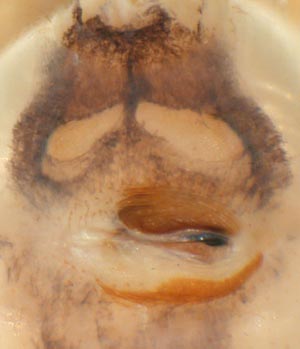
The gynander has on its left side a relatively normal epigynum as can be seen on this photo.
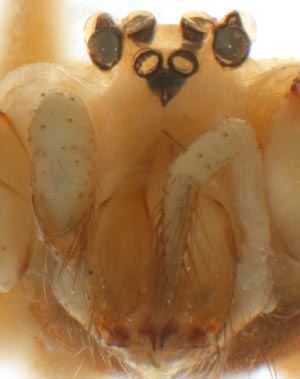 On the
right side, the specimen seems to be male, but the only character that
supports this view (externally) is the enlarged right palp that reminds
of the palp of a penultimate male. Since chelicerae and leg femora of
penultimate males are unmodified too, these sexually dimorphic traits
may not yet be expressed in this specimen.
On the
right side, the specimen seems to be male, but the only character that
supports this view (externally) is the enlarged right palp that reminds
of the palp of a penultimate male. Since chelicerae and leg femora of
penultimate males are unmodified too, these sexually dimorphic traits
may not yet be expressed in this specimen.Blackwall's (1867) specimen apparently had a fully developed male palp and modified male chelicerae on the left side and an epigynum on the right side. The left (male) legs were missing so he could make no statement about spines. He also failed to note the presence or absence of the female stridulatory apparatus (see below).
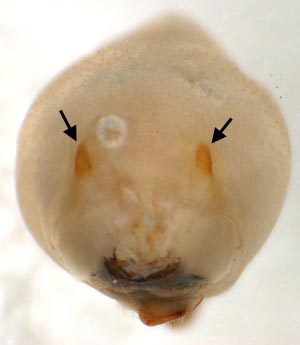 Most surprising is the female stridulatory apparatus: both
plates are developed on the abdomen (arrows) but none of the two cones
on the prosoma are developed.
Most surprising is the female stridulatory apparatus: both
plates are developed on the abdomen (arrows) but none of the two cones
on the prosoma are developed.In the meantime, this has been published in a revision of the genus (Huber 2022).